First: Conjure the verb “sha-ka-ra” or “to thank.”
Second: put it in its gerund form “thanking,” and
Third: make it into an adverb: Thanking-ly.
In Arabic, this comes out to شكراً , or “Shukran.”
To revert momentarily to English, let’s examine the colloquial use of this phrase. “Thank you” is a commonplace expression, stated in honesty, sarcasm or in passing dozens of time a day. Hence it’s been shortened colloquially, from “thank you” to the simple “thanks.”
One astute classmate – a linguistics major – noted this adaptation and introduced it to Arabic. Now, instead of this cumbersome “shukran,” we toss to one another a casual “shuks.” “Thanks.”
*
One day three or so weeks ago we spent the first half of 3amiyya class learning fruits and vegetables. It was fun – reminded me of first-year Spanish class. (Although I can muse about the role of the United Nations in the developing world in Arabic, I can also still remember how to say “carrot” in Spanish. And until three weeks ago, hadn’t learned “carrot” in Arabic.) Oddly enough, the widest-used fusHa Arabic textbooks don’t teach fruits and vegetables. Perhaps because fusHa is a language of newspapers and the Qur’an. Now, I haven’t read the Qur'an, so please feel free to comment and correct me if I make a presumptuous statement. But I would venture to guess that mushrooms don’t come up much in the Qur’an.
After we flew through our teacher’s fruit and vegetable picture cutouts (really, can anyone distinguish between a cucumber, a zucchini and a pickle in any watercolor cutout? Why was I the only one in class to despair and make dying sounds after an hour of utterly incorrect guesses?!) our teacher opened up the floor for us to name ANY fruit or vegetable that we wished to translate into Egyptian Arabic. One classmate tried describing the fruit sold on every street corner out of a wooden cart usually pulled by a donkey. (Guys. I am not the person to romanticize non-U.S. locations and say something like that if it weren’t true. As a reminder of sights from this trip:)

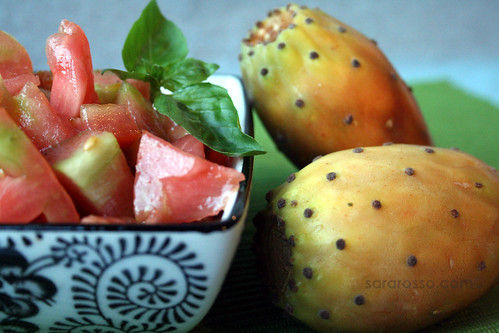
First we tried describing what a prickly pear is in Egyptian Arabic. This didn’t work. I made my way up to the board and drew what was OBVIOUSLY a pear with death-spikes erupting from its skin, which also failed to convey the idea. Finally we looked up photos on the internet, which our teacher recognized immediately.
So get this. The word for prickly pear in Egyptian Arabic is تين شوكي, “teen showkee.” Teen means “fig” (like, the fruit) and showkee takes the word “fork” and makes it an adjective: fork-y. So it's a fork-like…you see where I’m going with this…
A forky fig.


2 comments:
AAHahahah! Great stuff, thanks for being so diligent with the blog.
You guys in Arabic have it easy when it comes to "thank you" though.
In Turkish we use another form of sha-ka-ra which is much harder to pronounce (te-shek-kür), add the compounding Turkish verb (etmek), conjugate it into a tense that English doesn't even have (while remembering the consonant softening rule) and you get the whopping six-syllable "teşekkür ederim".
Wow. And someone told me Turkish is EASIER than Arabic. LIES!
You could take that saying and shorten it to "t-shuks." ;)
Post a Comment